
Global cloud spend is rising rapidly, but a significant portion of that spend does not produce business value because of sprawl, duplication, and inefficiency.
Public cloud spending is forecast to exceed 830 billion dollars in 2026, yet recent industry cloud usage analysis shows that about 30 percent of that spend is underutilized or wasted due to duplication, idle resources, and inconsistent ownership.
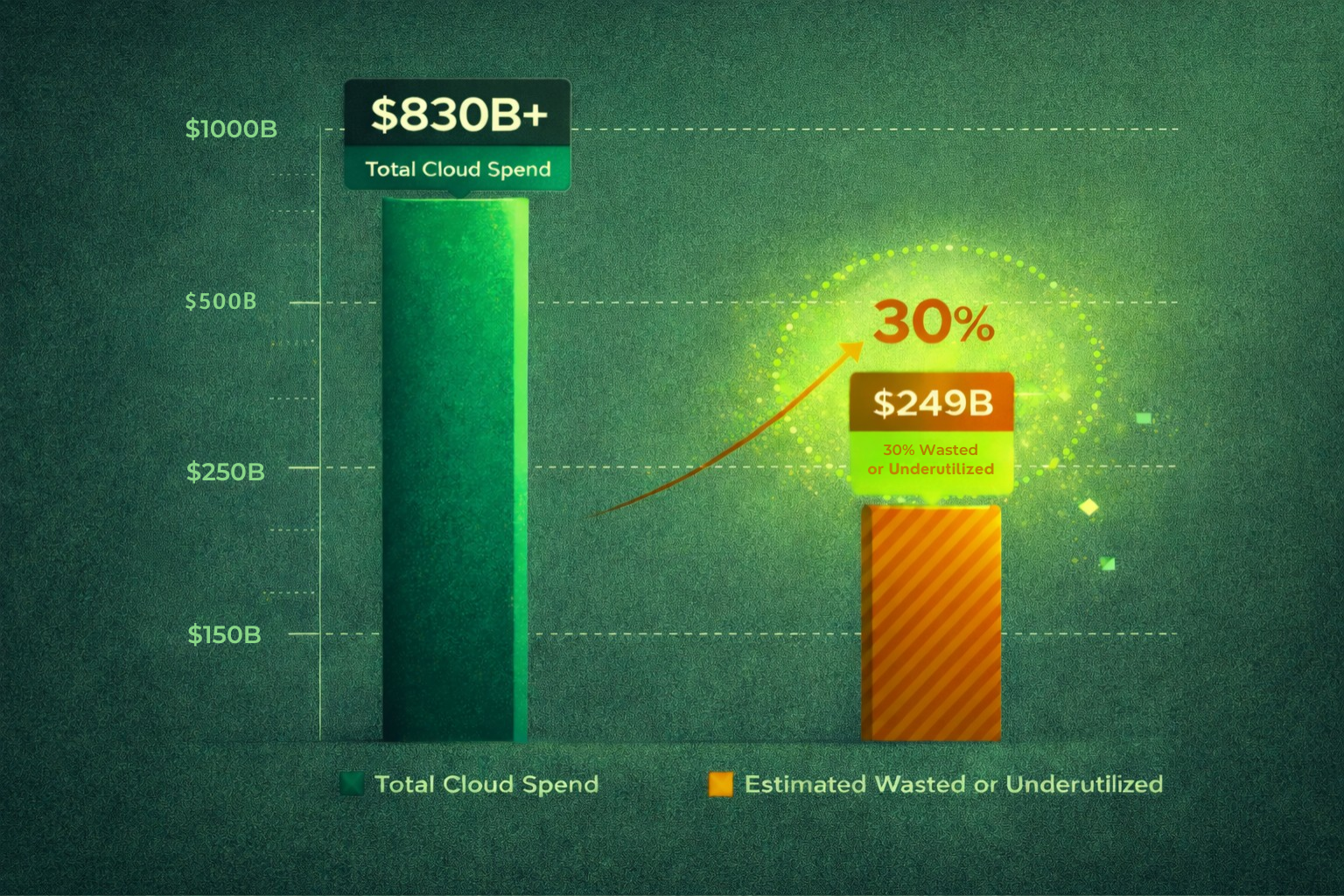
Global public cloud investment is projected to surpass 830 billion dollars in 2026, driven by AI workloads, data expansion, and distributed platforms. Most organizations are not questioning whether to use the cloud anymore. The conversation has shifted to cost control. FinOps has become the default response. Yet cloud bills continue to surprise leadership teams. The issue is not visibility alone. It is operational sprawl.
The Landscape Most People Assume
The common assumption is straightforward. If cloud costs are rising, the solution is better cost governance. More tagging. Better budgeting. Improved usage dashboards. Stronger FinOps review cycles. And to some extent, those measures help. Recent surveys indicate that over 80 percent of organizations now operate multi cloud environments. At the same time, independent research consistently shows that more than 30 percent of cloud spend is considered wasted or underutilized. Despite improved tooling, that percentage has not meaningfully declined over the past several years. The market conclusion is that cost discipline needs to mature. The deeper reality is that cost is a symptom of something structural.
The Real Constraint: Operational Sprawl, Not Billing Discipline
Cloud growth rarely happens through a single architectural decision. It accumulates through layers. New environments spin up for product launches. Temporary workloads remain active. Duplicate pipelines exist for separate teams. Legacy services coexist with modernized stacks. Data moves across regions without consistent ownership. Monitoring tools operate in silos. Individually, each decision makes sense. Collectively, they create sprawl.
FinOps can identify overspend. It cannot resolve fragmentation. When workloads lack architectural clarity, cost optimization becomes reactive. Teams negotiate budgets rather than fixing root causes. Engineers resize instances without consolidating redundant services. Dashboards show spend trends without explaining structural inefficiencies. Cloud operational efficiency is not just about spend reduction. It is about structural coherence. (Explore how data architecture shapes operational resilience in AI systems.)
What “Optimized” Still Gets Wrong
Many organizations believe they are optimizing because they have:
- Reserved instances in place
- Automated shutdown policies
- Tagging standards
- Quarterly cost reviews
Yet costs continue to rise faster than expected.
Why?
Because optimization at the surface does not eliminate duplication, unclear ownership, or inconsistent deployment patterns. When environments multiply without architectural guardrails, every new feature adds incremental overhead. Cloud providers report strong year over year revenue growth, partly because organizations continue expanding workloads faster than they consolidate them. Infrastructure growth often outpaces architectural discipline. (Discover why building systems right matters more than building fast.)
Recent cloud operational surveys indicate that the most reported causes of inefficiency are not primarily billing misconfiguration or missing tags. Instead, organizations frequently point to resource sprawl, overprovisioned compute, and uncoordinated workload deployments as leading structural causes of cost and performance drift.
This is operational sprawl.
What Cloud Operational Efficiency Actually Requires
True efficiency goes beyond FinOps dashboards. It requires platform-level decisions.
Production grade cloud efficiency includes:
- Clear workload ownership tied to accountable product teams
- Environment lifecycle management so temporary infrastructure expires automatically
- Consolidated data pipelines with single authoritative flows
- Observability that links cost spikes to workload behavior in real time
- Architectural standards that prevent duplication before it begins
Without these guardrails, cost management becomes an endless trimming exercise. With them, cost becomes predictable.
Market Reality in 2026
Cloud expansion is accelerating alongside AI adoption. AI optimized infrastructure spending alone is projected to double year over year. Organizations are provisioning compute capacity not only for storage and applications but for inference, training, and real time analytics. At the same time, industry studies continue to show that a meaningful percentage of cloud resources remain idle or underutilized. Many teams report that cost visibility improves, yet architectural complexity continues to grow.
This creates a paradox. Spending discipline increases, but structural inefficiency persists. FinOps teams can report. Platform teams must redesign.
Framework: Understanding Cloud Sprawl vs Cloud Efficiency
Area
What breaks without it
What operational efficiency looks like
Workload Ownership
Shared responsibility, no accountability
Single owner per workload with budget alignment
Environment Lifecycle
Orphaned test and staging systems
Automated expiration and environment governance
Data Movement
Cross region duplication, redundant pipelines
Consolidated authoritative data paths
Cost Visibility
Monthly surprises
Real time cost per workload mapping
Architecture Standards
Inconsistent deployment models
Reusable patterns and enforced platform guardrails
This is not a finance framework. It is an operating model framework.
Operational Implication: What Leaders Must Decide Now
If you lead platform, engineering, or product teams, cost conversations need to shift.
- Treat cloud sprawl as an architectural issue, not only a finance issue.
- Require every new workload to declare ownership, lifecycle, and cost expectation before deployment.
- Tie cost metrics to operational KPIs, not just budget targets.
- Audit duplication across environments before approving additional capacity.
Cloud cost optimization should reduce structural complexity, not only reduce invoices.
The Long View
Cloud growth is not inherently inefficient. It becomes inefficient when expansion outpaces discipline. FinOps is necessary. It is not sufficient.
Organizations that embed operational coherence into their cloud strategy see cost stabilize naturally as architecture matures. Organizations that rely only on reporting mechanisms continue cycling through budget escalations and reactive savings initiatives. Cloud operational efficiency is not achieved by trimming spend. It is achieved by designing systems that prevent sprawl from forming in the first place.
Outwork POV
At Outwork, cloud optimization begins with structural clarity. We focus on stabilizing workload ownership, embedding observability into cost behavior, and aligning platform governance with product accountability. When architecture becomes intentional, cost becomes predictable. When cost becomes predictable, innovation moves faster without creating hidden operational drag.
That is the difference between managing cloud bills and building cloud systems that scale responsibly.